A free AI adoption assessment, from the novel The Achilles Project
Find your
Achilles heel.
Every company can point to its AI stage on a slide. This shows the stage you're actually standing on, and the one weakness that decides what happens next.
Welcome back. See your last result →
The journey · Automedon, the operating system at the back of the book
Nine stages, in order.
Skipping is how you crash.
How it works
Three acts. The three questions every board ends up asking.
Fifteen scenes from real operations: a veteran retires, a new model ships, an auditor pulls a decision. Pick what actually happens in your building. Each answer comes with a short note on why it matters.
Find your stage-
I
How do you use it effectively?
Targeting, casting, and cadence. Where you aim the machine, which model you hire, and how fast you can change your mind.
-
II
How do you use it safely?
Owners, checks, and gates. Whose name is on the answer, what catches the fluent wrong one, and what runs by itself at 2 a.m.
-
III
How do you know if it's helping or hurting?
The honest number. Cost per record, held-out evals, and a record that holds up in front of an outside auditor.
What you get, free and instantly
A result you can put in front of your board.
- Your floor and your slide. The stage you stand on, the one you claim, and the rungs in between you skipped.
- Your Achilles heel. The single answer holding you off the next stage, and what that stage needs instead.
- The ten-piece target. Every piece of the operating system, scored, with the arrow on your weakest.
- Your next moves, straight from the book, and the chapters where they happen.
The novel
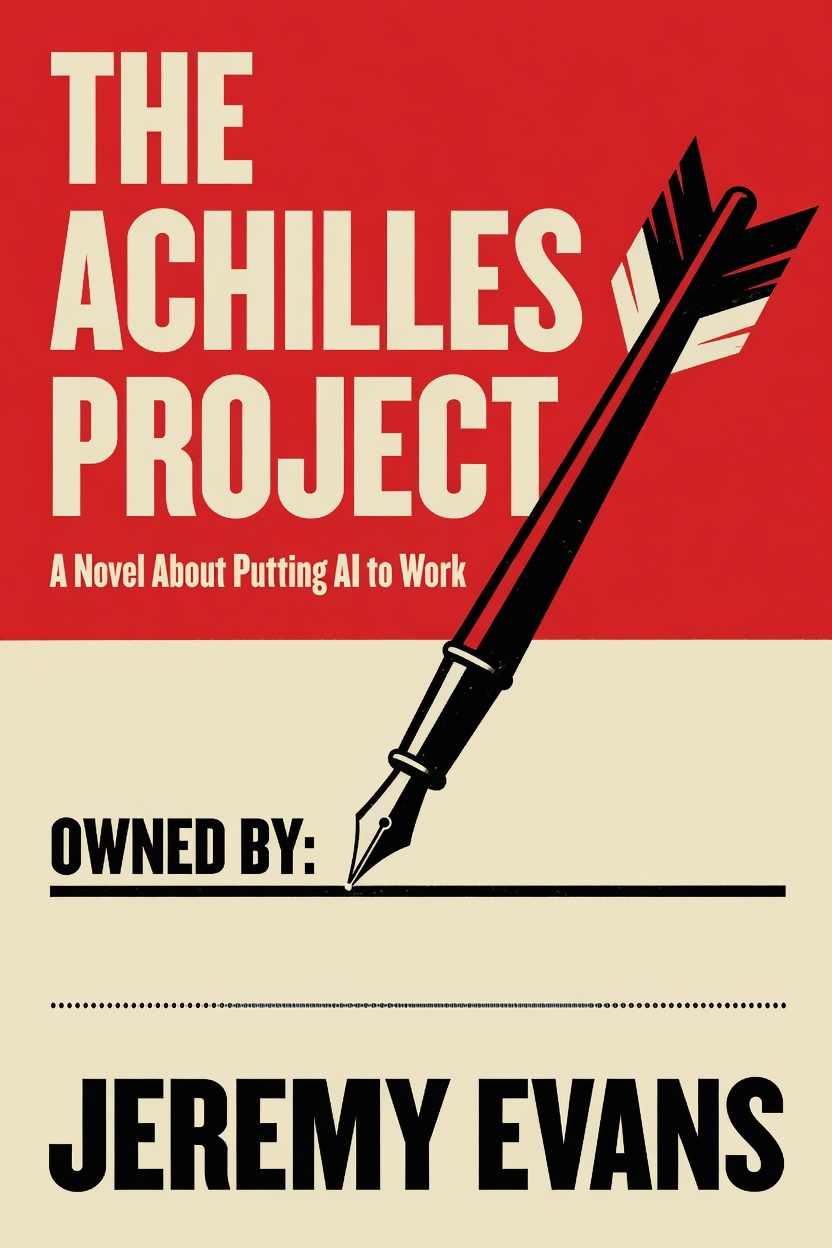
The Goal and The Phoenix Project, for putting AI into production.
Not a strategy deck. A novel about the part after it: a name on every answer, checks the prose can't talk past, and a meter on every call.
Lares Specialty Insurance is a four-billion-dollar trucking insurer with the body of a giant and the skeleton of a startup. An outsider VP of Operations bets its survival on AI. A state examination is 120 days out, and a fifty-five-million-dollar hole is hiding under a filter nobody reads.
Across twenty-nine chapters, Don Calder learns the operating system he later names Automedon: nearly every failure of AI adoption is organizational, not technical, and fast and safe are the same discipline.
What the author builds
The ideas in the book are also the author’s day job. These are the places they run.
- Thrice thrice.agency
The author’s engineering firm. It puts AI to work in revenue and operations teams, and it makes Alacritous and AgenticCodingCerts.
- Alacritous alacritous.io
The book’s operating system as software: AI agents that coordinate a team’s tools inside Slack, log every action and hand the decisions to a person to approve.
- AgenticCodingCerts agenticcodingcerts.com
How to build software with AI coding agents, taught as a free course, with a timed, human-reviewed certification for anyone who wants to prove the skill.
Marcus stood up with the month's figure. “$247,311.08,” he said. The new hire next to me leaned over. “He gave cents,” she whispered. “That's bad.”
from “It Ticked”
Plain answers
Before you begin.
Who's behind this, and what are they selling?
Full disclosure, said plainly: the author, Jeremy Evans, builds and sells these systems. The operating system in the novel is the working method of Alacritous, a product of Thrice, the author's firm. The fiction was kept clean of it: no product in the story is named or sold in it. Your result stays free; only the optional field guide, the book waitlist and the strategy-call waitlist ask for an email.
Why a novel, and not a playbook?
Because the failures that sink AI in production don't look like failures when they happen: a green dashboard, a fluent rationale, a great demo, a sensible ban. A story makes you sit through the week each rule didn't exist. You get the playbook too: the whole operating system is in the back of the book, bare, for anyone who wants to run it on Monday morning.
How is this different from books about AI strategy?
Strategy books end where this one starts. In the novel, the strategy is a single page handed over on the first morning. The rest of the book is the part that decides whether it works: who owns each answer, what checks it, what it costs per record, and whether the record holds up when an outsider pulls a file.
We're not an insurer. Will it apply?
The system rests on two tests that have nothing to do with insurance: can a machine now read this work, and is it cheap to be wrong? The last chapter makes the point in the story itself, when a freight-logistics leader maps the system onto her own operation: "Same ladder. Different nouns."
Is this another AI hype book?
No. In the novel the AI keeps failing until the company builds owners, checks and a meter around it. It grades a fatality as moderate, writes a perfect rationale on top of an error that became a zero, and one month costs $247,311.08. The book's thesis is that nearly every failure of AI adoption is organizational, not technical.
I don't have time to read a novel.
Start where your problem is. Each of the twenty-nine chapters turns on one problem, and the titles say which: "It Ticked" is the AI bill, and "Whose Throat to Choke" is ownership. If you want the system first, the back matter stands on its own.
Will it tell me which model or vendor to buy?
No, on purpose. The models in the novel are fictional, and the book calls its prices "period pieces" because they'll be out of date by the time you read them. What it gives you is the discipline for choosing: score any new model on your own held-out cases, cast each one to the task, and never sign away a falling price curve.
Is the book out?
Not yet. It's coming to Amazon. Join the waitlist and we'll send one email when it's there.
Is the company in the novel real?
No. Lares Specialty Insurance and everyone in it are fiction; in the author's words, the names in the novel are masks. The method isn't: it's the one the author's team builds for clients.
Why do so many AI projects stall?
Mostly for organizational reasons, not technical ones. RAND interviewed 65 experienced data scientists and engineers, and the first root cause they found was that stakeholders "misunderstand—or miscommunicate—what problem needs to be solved using AI" (RAND, 2024). McKinsey's 2026 survey finds that nearly nine in ten organizations use AI, but only 37% see any EBIT impact (McKinsey, 2026). The assessment looks for exactly that gap: the rung your floor is missing.
Do I need to read the book first?
No. The result, the field guide and the rules stand on their own. The novel is where you watch Don Calder climb the same rungs with 120 days on the clock, and its back matter lays out the whole operating system.
Who is this for?
Anyone who has to say where their company's AI adoption really stands: operations leaders, AI leads, and the finance and technology heads who share the call. The scenes are written for any industry. The novel happens to be set at an insurer; the questions aren't.
How is my stage scored?
Every answer is a real practice, and certain answers are the evidence a stage needs. A stage holds when every answer that evidences it is strong enough. Your floor is the highest stage that holds with every stage below it holding too. Your slide is the highest stage any of your answers reach, and the stages between them are the rungs you skipped. Your Achilles heel is the weakest answer standing between your floor and the next stage.
Where do my answers go?
Your answers are scored in your browser, and this browser remembers your progress so you can come back. Your result lives in its own link, which is why sharing it needs no account. When you finish, an anonymous record of your calculated stage helps us compare completed assessments, and your ten-piece values contribute to monthly averages. The completion keeps neither your result code, your page-visit ID nor your individual score profile. For the optional field guide, we store your email, any name you give, and your result for 24 months, and delete them when you ask. How we handle your data The book waitlist stores your email and launch-only consent, with any campaign tags or referring domain, without your answers or result. We also count which steps visitors reach, with no cookies.
What happens if I join the call waitlist, and what does it cost?
Alacritous takes a limited number of strategy calls, so there's a waitlist. You see your real place in it, and Alacritous works through it in order, emailing you when it's your turn. When you join from a result, your request includes that result. The assessment and the field guide are free. Alacritous's work is a paid service, and it discusses scope and cost with you directly, not on this site.
Your slide says one stage.
Your floor says another.
Find your stage
A conversation with Alacritous, the author's firm. Calls are limited, so there's a waitlist.